
Buyer guide · Updated November 2026
How to Buy Property in Phuket
The complete buying process for foreigners in 2026: what you can legally own, the eight steps from offer to keys, the documents you need, how long each stage takes, who pays which fee, and the mistakes that cost buyers money.
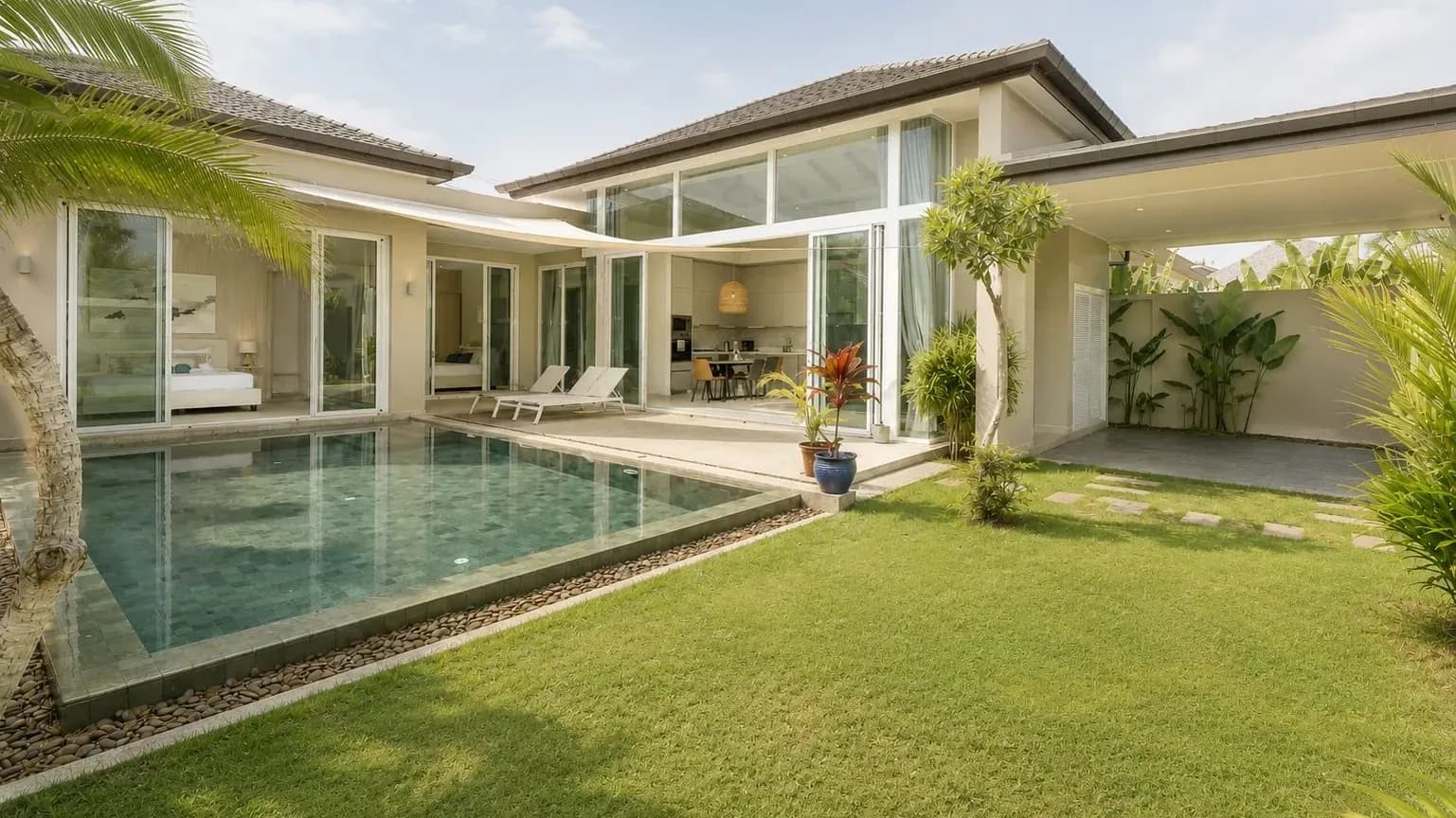
A 3-bedroom pool villa in Cherng Talay, from our listings
Section 1
How do you buy property in Phuket as a foreigner?
You choose a property you can legally hold — a condo unit freehold in your own name, or a villa through a registered lease of up to 30 years on the land — reserve it with a deposit that is refundable if the checks fail, let an independent lawyer review the title, sign the sale contract, bring the money in from abroad, and register the transfer at the Land Office. A resale usually completes 30–60 days after the contract is signed.
The process is well established and the Land Office registry is reliable, but Thailand puts the burden of checking on the buyer: there is no title insurance culture, agents are not lawyers, and a deposit paid before the checks is hard to recover. The order of the steps below is the order that protects you — documents before deposits, and money only once the title, the seller and the ownership route have been verified.
Two rules shape everything else. A foreigner cannot own land in their own name (Land Code, section 86), and a condo unit can only be registered in foreign freehold if the building is within its 49% foreign quota and the price arrives in Thailand in foreign currency. Our foreign ownership guide explains every legal route in detail; this guide focuses on how a purchase actually runs, from the first viewing to the keys.
Rules reflect the Land Code, the Condominium Act and the Civil and Commercial Code as applied by Phuket Land Offices in late 2026. Rates and fee ranges are those set out in our taxes and due diligence guides; they are indicative, not quotes.
Section 2
What can a foreigner buy in Phuket?
Before you view anything, match the property type to a legal ownership route. A condo can be owned outright; a villa or plot is held through a registered lease on the land, with the house itself usually in your name.
Condominium unit
Permanent ownership in your own name on a condo title deed, provided foreigners together hold no more than 49% of the building’s unit area (Condominium Act, section 19 bis) and the purchase money is remitted from abroad in foreign currency. Ask for a written foreign quota letter before you pay any deposit.
Villa, house or land
A lease of the land registered at the Land Office for up to 30 years (Civil and Commercial Code, section 540). The house can be registered in your own name as a separate building, often with a superficies right. A lease of over three years that is not registered is enforceable for three years only (section 538).
Leases are often marketed as “30+30+30” or longer. Only the first 30-year term is registered; the renewals are contractual promises that bind the lessor who signed them and depend on how they are drafted, so they are not registered rights you can rely on in the same way. When a condo building’s foreign quota is full, the same leasehold route is used for the unit.
A genuine, properly capitalised Thai company can own land, but a company whose Thai shareholders only hold shares on a foreigner’s behalf is a nominee structure, which is illegal under the Land Code and the Foreign Business Act. The Department of Lands has tightened its checks in 2026 and plots held through nominees are being ordered sold. Our guide to Thai company and nominee risks explains the difference.
Ask who the Thai shareholders are, what capital they paid in and what business the company really runs. If the answers are “friends of the lawyer”, “none” and “none”, walk away and use a registered lease instead.
Section 3
The buying process, step by step
A typical resale purchase runs through eight stages. The timings below are those we see on Phuket transactions; an off-plan purchase follows the same legal steps, but the transfer only happens when the building is finished.
Step 1Before you fly
Set the brief and the full budget
Decide the area, property type, ownership route and total budget — price plus your share of transfer taxes, lawyer fees, furniture and, for a condo, the sinking fund. Decide now how the money will reach Thailand.
Step 21–4 weeks
Search and viewings
Shortlist properties that fit a legal route, then view them, ideally at different times of day. Ask the agent for a copy of the title deed and, for a condo, the foreign quota position before you fall in love with a unit.
Step 3Day 0
Offer and reservation
Agree price, furniture, payment schedule and who pays which fee in writing. Pay a reservation deposit under an agreement stating that it is refunded if due diligence fails, and have the seller sign an authorisation for the Land Office search.
Step 41–4 weeks
Due diligence by your own lawyer
An independent Thai lawyer checks the deed and its encumbrances, the seller’s right to sell, permits, access and, for a condo, the quota and debt-free letters. Expect one to two weeks for a condo and three to four for a villa.
Step 5After the report
Sale and purchase agreement
Sign a bilingual contract that names the price, the transfer date, the split of fees, what happens if either side defaults, and the conditions that must be met before you pay. On a resale a deposit of around 10% is typical at this stage.
Step 6Before transfer
Bring the money in
Remit the price from abroad in foreign currency. For a freehold condo you need the FET form (for transfers of USD 50,000 or more) or the bank’s credit advice for each transfer; the Land Office will not register foreign freehold without them.
Step 7Usually 30–60 days after signing
Transfer at the Land Office
Buyer and seller, or their attorneys, attend the Land Office. Taxes and fees are paid, the seller receives cashier’s cheques, the mortgage is released if there was one, and the title is registered in your name or your lease is registered.
Step 8Same day
Handover and after
Check the new deed, collect keys and remotes, move the electricity and water accounts, and register as owner with the condo’s juristic person or the estate manager. Keep every receipt, FET form and the deed in a safe file: you will need them when you sell.

In Phuket, deeds are held by the provincial Land Office in Phuket Town or by its Thalang or Kathu branch, depending on where the plot is. The transfer itself is done in a single sitting, usually in a morning, once every document is ready. You do not have to be there: a lawyer can sign for you under a power of attorney on the Land Office form, notarised and legalised by a Thai embassy or consulate if you sign it abroad.
Buying off-plan works differently on the money side: a reservation deposit, then typically 20–30% at contract and instalments tied to construction milestones over 18–36 months, with the balance at transfer. Escrow is voluntary in Thailand, so check the developer as a lender would. Our buying off-plan guide covers payment schedules and developer checks.
Section 4
Which documents do you need to buy property in Phuket?
As a buyer you need fewer documents than the seller: a valid passport, proof that the money came from abroad, and the signed contract. Most of the paperwork your lawyer collects is about the property and the seller.
| Document | Who provides it | Why it matters |
|---|---|---|
| Passport (and copies) | You | Identifies you at the Land Office; the name must match the remittance and the contract |
| FET form or credit advice | The Thai bank receiving the funds | Proves the price arrived in foreign currency; required for condo freehold |
| Reservation agreement | Seller or developer, reviewed by your lawyer | Fixes price and terms; should make the deposit refundable if checks fail |
| Sale and purchase agreement | Drafted or reviewed by your lawyer | Sets the transfer date, fee split, conditions and default remedies |
| Certified copy of the title deed | Land Office, at the seller’s authorisation | Shows the owner and every mortgage, lease or servitude registered |
| Foreign quota letter | Condo juristic person | Confirms foreign freehold is still available for the unit |
| Debt-free letter | Condo juristic person | Without it the Land Office will not register a condo transfer (s.29) |
| Lease agreement on the Land Office form | Lessor and lessee | Registers your 30-year lease of the land for a villa |
| Power of attorney | You, if you cannot attend | Lets your lawyer sign at the Land Office; notarised and legalised if signed abroad |
Section 5
How much does it cost to buy, and who pays what?
On a typical resale, transfer taxes and fees come to roughly 6% of the value, and they are usually shared. Only the 2% transfer fee concerns every buyer; the business tax or stamp duty and the withholding tax are normally the seller’s, but every split is negotiable and belongs in the contract.
| Cost | Rate | Typically paid by |
|---|---|---|
| Transfer fee | 2% of the appraised value | Buyer and seller, often split 50/50 |
| Specific Business Tax | 3.3% of the higher of appraised or sale price | Seller (owned less than 5 years) |
| Stamp duty | 0.5% of the registered value | Seller (only when SBT does not apply) |
| Withholding tax | Progressive (individuals) / 1% (companies) | Seller |
| Lease registration | 1% fee + 0.1% stamp duty on the total rent | Lessee, or split |
| Mortgage registration | 1% of the loan (capped) | Borrower |
| Independent lawyer | ฿20,000–40,000 condo; ฿30,000–80,000 villa | Buyer |
| Sinking fund | One-off, set by the building | Buyer (condos) |
| Common-area fees | Monthly, per m² | Owner (condos) |
Most of these charges are calculated on the Department of Lands’ appraised value, which is often below the market price; Specific Business Tax and the company withholding rate use the higher of the appraised value and the sale price. SBT and stamp duty never apply to the same sale. With new developments, the developer sets the split in advance — some absorb part of the transfer costs, others pass most of them to the buyer — so confirm it before you reserve.
Declare the real price at the Land Office. An under-declared price is tax evasion, weakens your position if the sale has to be unwound, and leaves you with a low acquisition value — and a higher tax bill — when you sell. Our buying costs and taxes guide explains each charge, and the buying costs calculator works them out for a given price.
Section 6
How long does it take to buy property in Phuket?
A condo resale with clean papers can complete in about a month after the contract; a villa on a lease usually takes longer because there is more to check and the lease must be drafted. Off-plan depends on the construction schedule.
| Purchase | Legal review | Contract to transfer | What usually slows it down |
|---|---|---|---|
| Resale condo, freehold | 1–2 weeks | Usually 30–60 days | Quota or debt-free letter, FET paperwork for the funds |
| Resale villa, registered lease | 3–4 weeks | Usually 30–60 days | Access servitude, permits vs plans, lease drafting, boundary checks |
| Off-plan condo or villa | About 2 weeks before the first instalment | At completion, often 18–36 months | Construction delays, permits, condominium registration |
Allow extra time for anything that involves a third party: a seller’s bank releasing a mortgage, heirs registering an estate, a neighbour registering a right of way, or a Land Office boundary verification when the markers are missing. A seller who wants to transfer “next week” before your lawyer has the deed copy is a reason to slow down, not speed up.
Section 7
The mistakes that cost buyers money
Almost every problem we see on Phuket purchases comes from one of these shortcuts. Each is cheap to avoid and expensive to fix.
A non-refundable deposit before the checks
Make the reservation deposit refundable if due diligence fails, in writing. Pressure to pay a large sum “today” removes your leverage.
Using the seller’s or developer’s lawyer
Their lawyer protects their client. Choose your own licensed Thai lawyer, agree the scope and fee in writing and ask for a written report.
Bringing the money in the wrong way
Cash, crypto or baht from a Thai account without an FET form or credit advice can mean you cannot register a condo in foreign freehold.
Counting on “30+30+30”
Only the first 30 years are registered. Price a leasehold villa on the registered term and treat renewals as a bonus.
Nominee shareholders
Buying land through Thai shareholders who hold shares for you is illegal, and plots held this way are being ordered sold in 2026.
A verbal foreign quota
Without a written quota letter dated close to transfer, you may end up with a leasehold on a unit you paid for as freehold.
Ignoring permits and access
An extension built without a permit or a villa reached over a neighbour’s land without a registered servitude can block resale.
Budgeting only for the price
Add your share of transfer taxes, lawyer fees, furniture, the sinking fund and a year of running costs before you make an offer.
Section 8
After the transfer: running costs, renting out and visas
Once you own the property, plan for the annual Land and Building Tax, condo fees, maintenance and, if you let it, Thai income tax on the rent. Owning property does not give you a visa.
Financing is the other question buyers ask late, and it should be asked first: Thai banks lend to foreigners only in narrow cases, so most of our international buyers pay cash, borrow against property at home or use a developer’s instalment plan. Our financing guide sets out the realistic options.
This guide is general information, not legal or tax advice; Empire Estates is a real-estate agency, not a law firm. Rates, fee ranges and timings are indicative and reflect Thai law and Land Office practice as we understand them on 6 November 2026. Always have an independent licensed Thai lawyer review a specific property before you commit.
FAQ
Buying property in Phuket — your questions
Short answers to what buyers ask us most before they commit.
Talk to a local expert
Buy in Phuket with the checks done first
Tell us what you are looking for. We confirm the title, the ownership route and the foreign quota before you view, introduce an independent lawyer, and follow your file to the Land Office in English, French or Thai.
Sources
The legal texts, official sources and analyses this guide relies on (checked 6 November 2026). English translations of Thai statutes are unofficial; the Thai text prevails.
- Land Code B.E. 2497 (sections 86 and 111–113) — FAOLEX / FAO
- Thailand condo foreign ownership quota: the 49% rule (ss.19, 19 bis) — Thai Law Online
- The FET form in Thailand: bringing money in to buy a condo — Thai Law Online
- Foreign exchange transaction form threshold raised to USD 50,000 — Bank of Thailand (2010 notice)
- Civil and Commercial Code, section 540 (maximum lease term) — Thai Law Online (unofficial translation)
- Civil and Commercial Code, section 538 (registration of leases over 3 years) — Thai Law Online (unofficial translation)
- Department of Lands (Land Offices, registration, appraised values) — Department of Lands, Ministry of Interior (official)
- Income tax on the sale of immovable property: deduction by years held — The Revenue Department (in Thai) (official)
- Stamp duty schedule (lease of land and buildings) — The Revenue Department (official)
- Condominium disputes: concerns of joint owners (debt-free certificate, unpaid fees) — Tilleke & Gibbins
- Standard purchase agreements protecting condo buyers — Tilleke & Gibbins
- Department of Lands tightens checks on nominee land deals — The Nation (May 2026)