
Ownership guide · Updated October 2026
The 49% Foreign Quota Explained
How Thailand’s condo foreign quota really works in 2026: what the 49% is measured on, who counts as a foreign buyer, how to bring your money in, how to check the quota left in a building, what to do when it is full — and why the 75% proposal is still only a proposal.
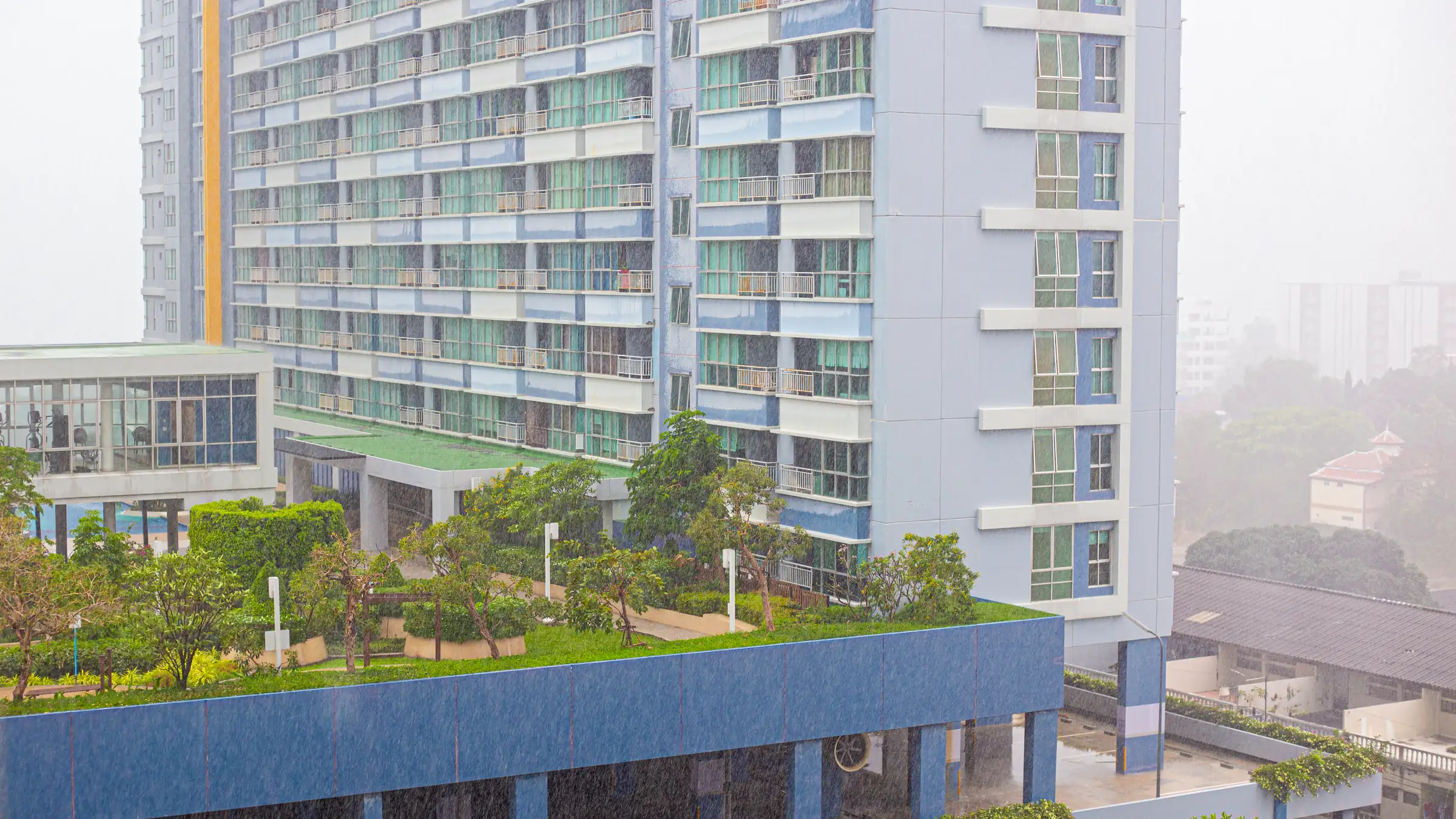
A condominium building in Thailand
TL;DR
What is the 49% foreign quota for condos in Thailand?
Under section 19 bis of the Condominium Act B.E. 2522, foreigners together may own up to 49% of the combined floor area of all units in a condominium building — square metres, not number of units. Each foreign buyer must bring the full price in from abroad in foreign currency. As of October 2026, the 75% idea is not law.
This guide reflects the Condominium Act B.E. 2522 as amended (sections 19 and 19 bis), Land Office practice for foreign-quota registrations and the transfer fees in force in October 2026. The proposal to raise the quota to 75%, approved in principle by the cabinet in June 2024, had not been tabled in parliament as a bill on 30 October 2026. We review this guide at least every six months.
- of the total floor area of all units
- 49%
- must stay in Thai ownership
- 51%
- per transfer: the level from which banks issue an FET form
- USD 50,000
- Land Office transfer fee on the appraised value
- 2%
The quota is the only door to freehold property that Thai law opens to foreigners: you cannot own land, but you can own a condominium unit in your own name, with a title deed (Or Chor 2), for ever. That is why the quota matters so much in Phuket, where many popular buildings in Bang Tao, Kamala, Patong and Kata sold their foreign quota years ago. The sections below explain how the 49% is counted, how to prove your money came from abroad, how to check what is left, and what your options are if a building is full.
The calculation
How is the 49% calculated: units or square metres?
In square metres. Section 19 bis caps foreign ownership at 49% of the combined area of all units in the building, as registered with the Land Office. Common areas such as the lobby, pool and corridors are not counted. A building can therefore be “full” with far fewer than half of its units sold to foreigners.
| Item | Area |
|---|---|
| Total area of all units | 10,000 m² |
| Maximum foreign quota (49%) | 4,900 m² |
| Already foreign-owned | 4,780 m² |
| Quota left | 120 m² |
Illustrative example built on section 19 bis of the Condominium Act B.E. 2522. Real figures come from the building’s juristic person and the Land Office.
In this example, a 35 m² studio could still be registered in foreign freehold, but a 150 m² penthouse could not: the Land Office checks the area of the unit you are buying against the quota left on the day of transfer. If the remaining quota is smaller than your unit, the whole unit has to go into Thai ownership or be bought on a lease.
| Same 100-unit building | Units sold to foreigners | Foreign share of floor area | Quota status |
|---|---|---|---|
| Foreigners bought mostly studios (35 m²) | 60 of 100 | About 40% | Quota still open |
| Mixed purchases | 49 of 100 | Around 49% | Full or nearly full |
| Foreigners bought the large sea-view units (150 m²) | 30 of 100 | Can already reach 49% | Full |
Two consequences follow. First, a sales agent who says “only 40 units are foreign-owned” has not told you whether there is quota left — ask for the area. Second, the quota moves: when a foreign owner sells to a Thai buyer, that unit’s area leaves the foreign quota and becomes available again; when a Thai owner sells to a foreigner, it is used up.
Foreign buyers
Who counts as a foreign buyer under the quota?
Section 19 of the Condominium Act lists who may own units within the quota: foreign individuals or companies who bring in foreign currency, foreigners with Thai permanent residence, foreigners and companies admitted under the Investment Promotion Act, and Thai-registered companies treated as foreign under the Land Code. All of them use the 49%.
| Buyer | Uses the foreign quota? | Funding rule |
|---|---|---|
| Foreign individual (any visa, or none) | Yes | Full price brought in from abroad in foreign currency, or paid from a non-resident baht or foreign-currency account |
| Foreigner with Thai permanent residence | Yes | Exempt from the foreign-currency rule (s.19) |
| Foreigner or company admitted under the Investment Promotion Act (BOI) | Yes | Exempt from the foreign-currency rule (s.19) |
| Thai company that is “foreign” under Land Code ss.97–98 (more than 49% foreign capital, or foreigners are more than half the shareholders) | Yes | Treated as a foreign buyer |
| Thai national, including one married to a foreigner | No — Thai quota | No foreign-currency rule; the unit belongs to the Thai spouse |
| Genuinely Thai-majority company | No — Thai quota | Only lawful with real Thai shareholders who paid for their shares; see our nominee guide |
Dual nationals who hold a Thai ID card buy as Thais and do not use the foreign quota. A foreigner married to a Thai can let the spouse buy a Thai-quota unit, but it is then the spouse’s property; the Land Department’s 2026 guidance asks officials to look more closely at purchases funded by a foreign spouse, so keep the paper trail clear. Buying through a Thai company “to get around the quota” is the riskiest option of all, as explained further down.
FET form
How must the money be brought into Thailand?
Send at least the full price from abroad in foreign currency and let the Thai bank convert it into baht. For each transfer of about USD 50,000 or more the bank issues a Foreign Exchange Transaction (FET) form; for smaller ones, ask for a credit advice. The Land Office needs these documents to register the unit in your name.
The FET form replaced an older Bank of Thailand form known as the Tor Tor 3 (ธ.ต.3). If you are buying a resale unit, the seller’s original Tor Tor 3 or FET shows how their money came in, and it supports the repatriation of their proceeds. If you sent money years ago and only have a Tor Tor 3, it is generally still accepted as evidence of that inflow — confirm with the Land Office through your lawyer.
Exchange-rate movements matter: the foreign currency must convert into at least the price registered at the Land Office, so leave a margin. Money already sitting in an ordinary Thai savings account (for example a salary paid in Thailand) does not qualify on its own, unless your bank can show it arrived from abroad in foreign currency. Foreigners with permanent residence or BOI status are exempt from this rule but still use the quota.
Checking the quota
How do you check how much foreign quota is left?
Ask the building’s juristic person — the legal management body of the condominium — for a dated, signed letter stating the foreign-owned percentage of the total unit area. The Land Office asks for this letter at transfer, together with a certificate that the unit has no unpaid common fees (section 29). Check before your deposit and again just before transfer.
Step 1
Ask before you reserve
Request the current foreign-owned area and percentage in writing from the juristic person manager, not from the seller or an agent. A verbal assurance is worth nothing at the Land Office.
Step 2
Compare with your unit’s area
Check that the quota left is larger than the registered area of the unit you are buying, as shown on its title deed (Or Chor 2) or in the developer’s unit schedule.
Step 3
Protect yourself in the contract
Make the deposit refundable if the unit cannot be registered in foreign freehold on transfer day. For off-plan units, the contract should allocate the unit to the foreign quota and set a refund if that fails.
Step 4
Get the transfer letters
Shortly before transfer, the juristic person issues the foreign-quota letter and the debt-free certificate. They are usually valid for a short period, so time them with the Land Office appointment.
In a popular building, the quota can disappear between your reservation and your transfer if other foreign buyers register first; the Land Office works in order of registration, not order of reservation. In a new project, the developer manages the allocation itself — ask how many square metres of foreign quota remain unsold and whether your unit is already earmarked for it.
When it is full
What can you do if the foreign quota is full?
You cannot register a Thai-quota unit in your own name. The lawful options are a registered lease of up to 30 years from the Thai owner, waiting for a foreign-quota unit to come up for resale, or choosing another building. Putting the unit in a Thai friend’s name or a nominee company is not a safe workaround.
| Option | How it works | Main risk |
|---|---|---|
| Registered lease (leasehold) | Lease of up to 30 years registered at the Land Office (CCC ss.538 and 540); 1% registration fee plus 0.1% stamp duty on the total rent | Renewal promises beyond 30 years are only contractual |
| Wait for a foreign-quota resale | Buy a unit already registered to a foreign owner; it stays in the foreign quota | Fewer units to choose from; often priced higher |
| Another building | Many Phuket projects still have quota, especially newer ones | Location or view may differ |
| Thai spouse buys | Lawful, but the unit is the spouse’s property | Divorce, death and inheritance; you own nothing yourself |
| Thai friend or nominee company | Someone else holds the title “for you” | Illegal if it disguises foreign ownership; you have no enforceable right and risk forced sale |
A Thai person who holds title for you is the legal owner: they can sell, mortgage or pass the unit to their heirs, and Thai courts will not enforce a side agreement that hides a foreign owner. A Thai company whose Thai shareholders did not really invest is a nominee structure: since May 2026 Land Offices must check the funding of Thai shareholders in companies with foreign shareholders or directors, and penalties include forced sale and criminal charges. Our guide to Thai company and nominee risks explains the rules.
A lease of a condo unit is a perfectly normal product in Phuket, especially for holiday use, but it is a 30-year right of use, not ownership. Price it on the first 30 years only, register it at the Land Office (an unregistered lease over three years is only enforceable for three years), and read our leasehold vs freehold guide before you sign a “30+30+30” contract.
Prices & resale
Freehold vs leasehold condo prices and resale
A foreign-freehold unit can be sold to any buyer, foreign or Thai, inherited and mortgaged; a leasehold unit is a wasting 30-year right. In buildings where the quota is nearly full, foreign-freehold units often ask more than Thai-quota units; where quota is plentiful the gap is usually small. There is no official statistic on this premium.
| Foreign freehold | Thai freehold (Thai quota) | Leasehold unit | |
|---|---|---|---|
| Who can buy it | Anyone | Thais (or a foreigner if the quota has room at transfer) | Anyone, as a tenant |
| Resale buyer pool | Widest | Mostly Thai buyers if the quota is full | Narrows as the term runs down |
| Typical price position | Highest in quota-tight buildings | Can be lower in foreign-buyer markets | Below freehold, falling with the years left |
| Inheritance | Passes to heirs; a foreign heir must qualify under s.19 | Passes to heirs | Depends on the lease wording and court practice |
| Costs at purchase (typical) | 2% transfer fee, often shared; seller pays SBT 3.3% or stamp duty 0.5% and withholding tax | Same as freehold | 1% lease registration + 0.1% stamp duty on the total rent |
For an investor, the quota is part of the asset’s value: a foreign-freehold unit in a sought-after Phuket building is easier to resell to the next foreign buyer than a unit that only a Thai can buy outright. Our buying costs and taxes guide breaks down every fee; our rental yield calculator helps you compare net returns between units.
The 75% debate
Will Thailand raise the condo foreign quota to 75%?
Not yet. In June 2024 the cabinet approved in principle a study of a 75% foreign quota and 99-year leases, but the Interior Ministry said the draft was not ready, and no bill had been tabled in parliament by 30 October 2026. The 49% cap of section 19 bis remains the law.
Step 1June 2024
Cabinet directive in principle
The government asks the Interior Ministry and the Land Department to study raising the condo foreign quota from 49% to 75% and allowing residential leases of up to 99 years, as stimulus measures.
Step 2June 2024
“Not ready yet”
Then Interior Minister Anutin Charnvirakul says the bill is not ready and that any increase would keep Thai owners in control of the building’s votes.
Step 32024–2025
Public debate and opposition
Critics raise sovereignty, housing-affordability and “foreign enclave” concerns; versions limited to some provinces or price levels are discussed but none is drafted into law.
Step 4Aug–Sep 2025
99-year rights consulted for state land only
A draft on 99-year leasehold rights over state property goes to public consultation; it does not touch the condo quota or private villas.
Step 52026
Priority shifts to nominee enforcement
The government concentrates on unwinding illegal nominee holdings; the 75% quota does not reach parliament.
Step 630 October 2026
Status today
Proposal only. The 49% quota applies to every registration at the Land Office.
Even if a change is passed one day, it would take an act of parliament published in the Royal Gazette, and drafts discussed so far would apply only in certain areas or above a price threshold, with Thai owners keeping voting control. Do not pay a premium, or accept a Thai-quota unit, on the promise that the quota will rise.
Step by step
How a foreign freehold condo purchase works, step by step
A resale purchase in foreign freehold typically takes four to eight weeks from reservation to keys: reserve and check the quota, let your lawyer review the title and contract, sign and pay the deposit, transfer the funds from abroad, obtain the juristic person’s letters, then register the transfer at the Land Office and receive the title in your name.
Step 1Day 1
Reservation
What to watch: A modest refundable reservation fee, conditional on foreign quota and a clean title.
Step 2Week 1–2
Lawyer’s due diligence
What to watch: Title deed (Or Chor 2) and encumbrances, building registration, juristic person accounts, unpaid fees, quota letter.
Step 3Week 2
Sale contract and deposit
What to watch: Bilingual contract, who pays which fee, refund if foreign freehold registration fails.
Step 4Week 2–5
International transfer
What to watch: Foreign currency, your name, the purpose of the transfer; collect the FET form or credit advice.
Step 5Week 4–6
Juristic person letters
What to watch: Foreign-quota letter and debt-free certificate (s.29), dated close to the transfer.
Step 6Week 4–8
Land Office transfer
What to watch: Fees paid, title registered in your name; then update the juristic person’s owner register and utilities.
Off-plan purchases follow the same logic over a longer period: the developer allocates the unit to the foreign quota in the sale contract, each instalment is wired from abroad, and the Land Office transfer takes place only once the building is completed and registered as a condominium. Our buying process guide details each step, and our off-plan guide explains how to protect your instalments.
With Empire Estates
How we help you buy a condo in foreign freehold
We state on every condo listing whether the unit is foreign freehold, Thai quota or leasehold, ask the juristic person for the quota position before you visit, and coordinate the bank transfer paperwork with you and your independent lawyer. Our team in Cherng Talay speaks English, French and Thai.
Quota checked first
We ask for the building’s written quota position before you fall for a unit.
Tenure stated clearly
Foreign freehold, Thai quota or leasehold — on the listing, not at the contract stage.
FET paperwork
We explain the transfer wording and documents to your bank and lawyer before you send money.
Independent lawyers
We introduce Thai lawyers who work for you, not for the seller or for us.
This guide is general information, not legal or tax advice. It reflects Thai law and Land Office practice as we understand them on 30 October 2026; section numbers refer to unofficial English translations, the Thai text prevails, and Land Offices can differ on the documents they accept. The building figures in the chart are an illustration, not data from a real project. Always have an independent Thai lawyer check the title, the quota letter and your transfer documents before you pay.
FAQ
The 49% condo foreign quota — your questions
Short answers to what foreign buyers ask us most.
Talk to a local expert
Looking for a condo with foreign quota?
Tell us your budget, the area you like and whether you want to live in the unit or rent it out. We will shortlist condos with confirmed foreign freehold, check the quota in writing and walk you through the FET paperwork.
Where to buy
Condos, areas and tools
Browse condos with their tenure stated, compare the areas where most foreign-quota buildings stand, and run the numbers before you choose.
Condo listings
Units across Phuket, with foreign freehold, Thai quota or leasehold stated.
West coast condo areas
Beach areas where many buildings sell out their foreign quota first.
South, town and inland
Quieter or more local markets where foreign quota is often easier to find.
Sources
The legal texts, law-firm analyses and official announcements this guide relies on (checked 30 October 2026). English translations of Thai statutes are unofficial; the Thai text prevails.
- Thailand condo foreign ownership quota: the 49% rule (ss.19, 19 bis) — Thai Law Online (updated October 2026)
- The FET form in Thailand: bringing money in to buy a condo — Thai Law Online
- Inheritance of condominium units by foreigners in Thailand (Condominium Act ss.19 and 19 bis) — Tilleke & Gibbins
- Land Code B.E. 2497 (sections 86, 97 and 98: companies deemed foreign) — FAOLEX / FAO
- Civil and Commercial Code, section 540 (maximum lease term) — Thai Law Online (unofficial translation)
- Civil and Commercial Code, section 538 (registration of leases over 3 years) — Thai Law Online (unofficial translation)
- Government directive on 99-year leases and a 75% condo quota (June 2024) — Government Public Relations Department
- Bill boosting foreign ownership of condos not ready yet: Anutin — The Nation (June 2024)
- 99-year leasehold rights over state property: draft amendment and consultation — The Nation (2025)
- Department of Lands tightens checks on nominee land deals — The Nation (May 2026)