
Ownership guide · Updated October 2026
Leasehold vs Freehold in Thailand
Freehold means you own the property outright and forever; leasehold means you rent it, on a registered contract, for up to 30 years. Here is what each one gives a foreign buyer in Phuket, what it costs and which one fits your purchase.
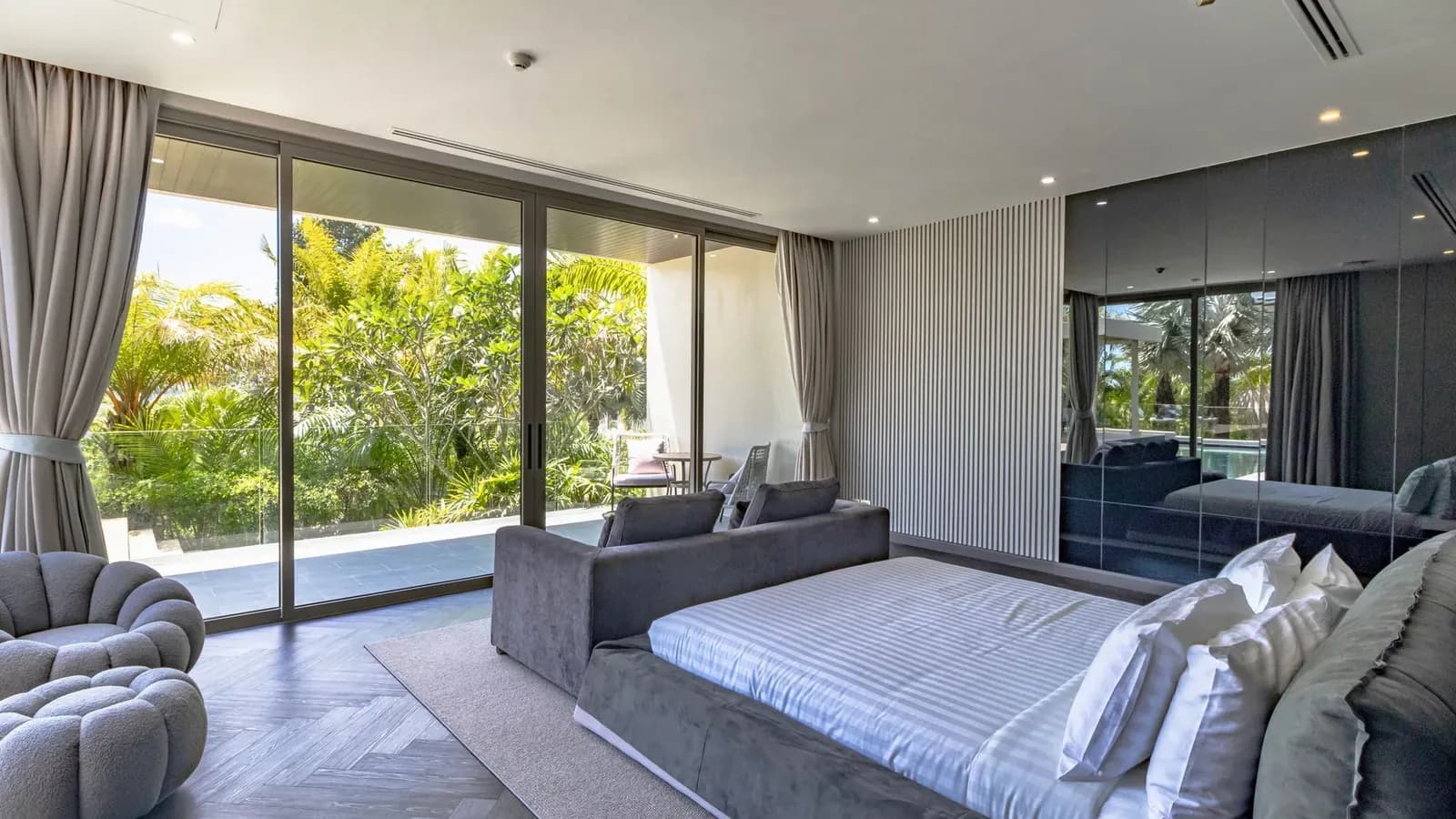
A villa for sale in Layan, from our listings
The short answer
Leasehold vs freehold: what is the difference?
Freehold is permanent ownership registered on a title deed; leasehold is a registered right to use someone else’s property for a fixed term, capped at 30 years for homes in Thailand. As of 2026, a foreigner can hold a condo unit freehold, but land — and therefore most villas — only through a lease.
| Freehold | Leasehold | |
|---|---|---|
| What you hold | Ownership of the property, registered in your name | A contractual right to use the property, registered on the owner’s title deed |
| Duration | Permanent | Up to 30 years per term (Civil and Commercial Code s.540) |
| Open to foreigners for | Condominium units within the 49% foreign quota | Land, villas, houses — and condos when the quota is full |
| Sell, give or bequeath | Freely, like any owner | Transfer or sublet only if the contract allows it (s.544) |
| At the end of the term | Nothing ends | The property returns to the owner unless a new lease is registered |
| Main risk to check | Title, quota and the bank transfer paperwork | The lessor, the renewal wording and what happens on death or sale |
Thai law separates land from what is built on it. The Land Code (section 86) keeps land ownership for Thai nationals, while the Condominium Act lets foreigners own apartment units. Leases, superficies and usufructs are the legal tools that bridge the gap for everything else.
Freehold
What freehold means for a foreigner
For a foreign buyer, freehold in practice means a condominium unit owned in your own name under the Condominium Act B.E. 2522. You hold a unit title deed, there is no time limit, and you can sell, rent out, mortgage or leave the unit to your heirs, exactly as a Thai owner can.
You will see "foreign freehold" and "Thai freehold" on condo listings. Both are full ownership: the label only tells you which quota the unit sits in. A foreigner can only register a unit that is, or can be moved into, the foreign quota.
When a building’s foreign quota is full, a foreigner can still occupy a unit through a registered lease from a Thai owner — which is why the same building can be offered on both bases. Browse current freehold units on our condos for sale page.
Leasehold
How a registered leasehold works
A Thai leasehold is a hire contract over immovable property. The maximum term is 30 years (Civil and Commercial Code section 540), and a lease longer than three years must be in writing and registered at the Land Office — otherwise it can only be enforced for three years (section 538).
Step 1
Agree the contract
The lessor (the landowner or the developer’s land company) and you agree the term, the rent — usually prepaid in full for a villa — the renewal options, and whether you may assign or sublet. Have your own lawyer draft or review it.
Step 2
Register at the Land Office
Both parties, or their attorneys under power of attorney, register the lease. It is recorded on the back of the title deed, which makes it binding on anyone who later buys the land: section 569 says a lease is not extinguished when ownership is transferred.
Step 3
Secure the building separately
On a villa, the land is leased but the house can be owned by you. A registered superficies, and a building permit in your name, are the usual ways to prove it — see the next sections.
Step 4
Plan the exit
To sell, you assign the remaining lease term to a buyer, which needs the contract to allow assignment (section 544) and a new registration. The value of a lease naturally falls as its remaining years run down.

A lease is traditionally a personal right that ends with the lessee. In judgment 11058/2559 (2016), the Supreme Court’s General Assembly accepted that a long, prepaid, fixed-term lease can pass to the heirs, but the outcome depends on the contract. Insist on an express clause naming heirs and successors, and on a right to assign.
A leasehold is not an inferior product when it is built properly. Many of Phuket’s resort-branded villas and older beachfront estates are only ever offered on lease, because the landowner keeps the land. What matters is the quality of the lessor, the registration, and the wording on renewal, death and transfer.
Renewals & the 99-year myth
"30+30+30" and the 99-year lease: what is real in 2026?
Only the first 30-year term is guaranteed by registration. Renewal options are contractual promises to register a new lease later, and a 2023 Supreme Court ruling voided pre-agreed, prepaid extensions on a Phuket lease. A 99-year residential lease does not exist under Thai law as of October 2026.
Section 540 allows a lease to be renewed, but each renewal cannot exceed 30 years from the date it is made. That is why developers market "30+30+30": the first term is registered, the next two are written into the contract as options. Whether you ever get them depends on the lessor — or whoever owns the land by then — honouring and registering them.
In Supreme Court Decision 4655/2566 (B.E. 2566, i.e. 2023, published in commentary in 2025), the court looked at a 1990 lease in Phuket with extension periods agreed and paid for upfront. It held those extensions were a way around the 30-year cap and therefore void; the lessee had to leave and pay damages. Lawyers now advise against paying anything for renewal terms in advance.
| Proposal | What happened | Status in October 2026 |
|---|---|---|
| Residential leases of up to 99 years | Cabinet approved a directive in principle in June 2024; the Interior Ministry said the draft was not ready | Not law — the 30-year cap of s.540 still applies |
| Condo foreign quota from 49% to 75% | Part of the same June 2024 directive | Not law — the 49% quota still applies |
| 99-year rights over state-owned land | Draft amendment to the leasehold property rights (Sap Ing Sith) Act put to public consultation, Aug–Sep 2025 | Did not reach cabinet; would not cover private villas |
| Commercial & industrial leases of up to 50 years | Lease of Immovable Property for Commerce and Industry Act B.E. 2542 (1999) | In force, but only for approved commercial or industrial use — not homes |
Ask to see exactly what will be registered at the Land Office. In 2026 it will be a 30-year lease plus renewal promises. Judge the deal on the first 30 years alone, and treat anything beyond as a bonus that depends on the lessor.
Owning the house
Superficies, usufruct and habitation: owning the building on leased land
You can own a villa building in your own name even when the land is leased. Thai law presumes the landowner owns what stands on the land, so the standard protection is a registered superficies — the right to own buildings on another person’s land — matching the lease term, backed by a building permit in your name.
| Right (Civil and Commercial Code) | What it gives you | Duration | Transfer & inheritance |
|---|---|---|---|
| Lease (ss.537–571) | Use of the land or the whole property | Max. 30 years, renewable | Only if the contract allows; heirs per contract and case law |
| Superficies (ss.1410–1416) | Ownership of buildings on another’s land | Fixed term (max. 30, renewable) or for life | Transferable and inheritable unless excluded (s.1411) |
| Usufruct (ss.1417–1428) | Use of the property and its income | Max. 30 years or for the holder’s life | Ends on the holder’s death (s.1418); exercise can be transferred (s.1422) |
| Habitation (ss.1402–1409) | The right to live in a building | Max. 30 years, renewable, or for life | Not transferable, even by inheritance (s.1404) |
These rights are often layered. A typical foreign villa purchase combines a 30-year registered land lease, a superficies over the house for the same term, and a sale agreement for the building. A usufruct for life is popular with couples where the land is in a Thai spouse’s name, because it lasts as long as the foreign partner lives.
Each right is a separate registration at the Land Office and appears on the title deed. If a seller tells you a right exists, ask to see it on a certified copy of the deed.
Choosing
Which should you choose: leasehold or freehold?
Choose freehold if you want an apartment you can keep, resell easily and pass on: a condo within the foreign quota is the only true freehold open to you. Choose a well-drafted leasehold for a villa or land, where it is the standard legal route, and price it on the first 30 years.
Best for apartments and long-term holding
Permanent title, a wide resale market and the simplest inheritance. Limited to condos, and you depend on the building still having foreign quota when you buy — and when you sell to another foreigner.
Best for villas, land and resort homes
The normal way for a foreigner to hold a villa, often at a lower entry price than a comparable freehold, with the house owned in your name. Its value declines as the term runs down, and renewals are never certain.
| Your plan | Usual structure | Why |
|---|---|---|
| Holiday apartment or rental condo | Freehold condo (foreign quota) | Permanent, simple, easy to resell |
| Family villa for 10–25 years | Registered 30-year lease + superficies | Covers the period you need; house in your name |
| Villa for life, married to a Thai national | Land in the spouse’s name + usufruct or lease | Protects the foreign partner’s right to stay |
| Land to build on | 30-year lease + superficies, or a genuine Thai company | Foreigners cannot own land; nominee shareholders are illegal |
| Condo when the quota is full | Registered lease from a Thai owner | The only option for that unit; check the renewal terms |
Our foreign ownership guide compares every route in detail, including the Thai company option and its nominee risks. Whatever you choose, check the title first: our land titles guide explains why a leasehold should only be taken over land with a Chanote title deed.
Costs
Costs and taxes: leasehold vs freehold
Registering a lease costs a 1% Land Office fee on the total rent for the whole term plus 0.1% stamp duty. A freehold condo transfer costs a 2% transfer fee on the appraised value plus the seller’s taxes, often split by negotiation. Both pay the low annual Land and Building Tax.
| Cost | Leasehold registration | Freehold transfer (condo) |
|---|---|---|
| Land Office fee | 1% of the total rent for the full term | 2% transfer fee on the official appraised value |
| Stamp duty | 0.1% of the total rent (and any key money) | 0.5% — only when Specific Business Tax does not apply |
| Specific Business Tax | Not applicable | 3.3% if the seller held the unit under 5 years, or is a company |
| Withholding tax | May apply to the lessor’s rental income | Paid by the seller on the sale |
| Who pays | Set by the contract — often the lessee | Set by negotiation — often split |
Under the Land and Building Tax Act B.E. 2562, the owner of the land, building or condo unit is the taxpayer; a lease can pass the cost to the tenant by contract. Residential rates are low, roughly 0.02–0.1% of the appraised value. See our buying costs and taxes guide for worked examples.
Before you sign
Leasehold checklist: 8 clauses to check
Before signing a lease in Phuket, confirm who really owns the land, that the title is a Chanote, and that the contract covers registration, renewal, assignment, death, sale of the land and the building. Have an independent Thai lawyer review it before any payment, and never prepay renewal terms.
With Empire Estates
How we help you choose the right structure
We tell you upfront whether a property is offered freehold or leasehold, show you the title deed and the draft lease, and introduce independent Thai lawyers who act only for you. Our role is to make the trade-offs clear before you commit, not after.
Clear tenure on every listing
Freehold, foreign quota or leasehold — stated before the viewing, not at the contract stage.
Title and quota checks
We request the deed and the building’s quota confirmation so your lawyer starts with real documents.
Independent lawyers
We introduce licensed Thai property lawyers who review the lease for you, not for the seller.
Honest about renewals
We value leases on the registered term, and say so when a "99-year" promise does not hold up.
This guide is general information, not legal or tax advice. It reflects Thai law and official practice as we understand them on 29 October 2026; section numbers refer to unofficial English translations, and the Thai text prevails. Rules and their application change — always have a licensed Thai property lawyer review your contract before you commit.
FAQ
Leasehold and freehold — your questions
Short answers to what foreign buyers ask us most.
Talk to a local expert
Not sure which structure fits?
Tell us the property and your plans — we will explain the tenure it is offered on, show you the documents and connect you with an independent lawyer.
Sources
The legal texts, official pages and law-firm analyses this guide relies on (checked 29 October 2026). English translations of Thai statutes are unofficial; the Thai text prevails.
- Civil and Commercial Code, section 540 (maximum lease term) — Thai Law Online (unofficial translation)
- Civil and Commercial Code, section 538 (registration of leases over 3 years) — Thai Law Online (unofficial translation)
- Civil and Commercial Code, section 569 (lease survives a transfer of ownership) — Thai Law Online (unofficial translation)
- Civil and Commercial Code, sections 1411–1412 (superficies) — Thai Law Online (unofficial translation)
- Civil and Commercial Code, section 1418 (usufruct) — Thai Law Online (unofficial translation)
- Civil and Commercial Code, section 1404 (habitation is not transferable) — Thai Law Online (unofficial translation)
- Thai Supreme Court strikes down automatic long-term lease renewals (Decision 4655/2566) — Addleshaw Goddard
- Inheritance of leasehold property in Thailand (Supreme Court judgment 11058/2559) — Tilleke & Gibbins
- Inheritance of condominium units by foreigners in Thailand (Condominium Act ss.19 and 19 bis) — Tilleke & Gibbins
- Hire of immovable property for commerce and industry by aliens — Department of Lands
- Stamp duty schedule (lease of land and buildings) — Revenue Department
- Land Code B.E. 2497 (sections 86 and 96 bis) — FAOLEX / FAO
- Government directive on 99-year leases and a 75% condo quota (June 2024) — Government Public Relations Department
- Interior Minister: lease and quota draft not ready for cabinet (June 2024) — The Nation
- 99-year leasehold rights over state property: draft amendment and consultation (2025) — The Nation
- Building ownership in Thailand (house on leased land, superficies) — DFDL
- Transferring money to buy a condo (FET form) — CBRE Thailand